 Love music trivia? 🎵 Try Weekly Spin, our daily social music discovery diary!
Complete Guide to Album Year Guess
Album Year Guess is one of our most popular and intellectually rewarding games, bridging the gap between musical appreciation, cultural history, and auditory pattern recognition. To excel at identifying the release years of albums, players must look beyond the names of the artists and delve into the technological, stylistic, and cultural movements that defined different eras. This comprehensive guide provides you with a robust framework for dating albums, covering music eras, production techniques, landmark albums, genre evolution, and practical gameplay tips.
Understanding Music Eras and Decades
The evolution of modern recorded music is closely tied to historical decades, each possessing a unique sonic fingerprint. The late 1950s and early 1960s saw the birth of rock and roll, defined by raw guitars and simple arrangements. By the mid-1960s, the British Invasion (led by The Beatles and The Rolling Stones) introduced complex instrumentation, folk influences, and the early stages of psychedelic music. The 1970s diversified the landscape, bringing progressive rock (Pink Floyd), hard rock (Led Zeppelin), soft California rock (Fleetwood Mac), disco, and the raw rebellion of punk rock. The 1980s were dominated by synthesizers, drum machines, and digital recording technology, creating the polished new wave, synth-pop, and hair metal sounds. The 1990s saw a massive swing back toward rawness, defined by grunge (Nirvana), alternative rock, Britpop, and the Golden Age of Hip-Hop. The 2000s introduced digital editing software (Pro Tools), indie rock revivals, pop-punk, and increasingly hybrid genres. By learning these decade characteristics, you can immediately identify the era of an album based on its overall sound and musical style.
Recognizing Production Techniques
Recording technology is one of the most reliable auditory clues for dating an album. In the 1960s, artists were limited by 4-track tape recorders, leading to creative bouncing techniques and a warm, sometimes compressed analog sound. The 1970s introduced multitrack recording (16-track and 24-track tape machines), allowing for pristine separation of instruments, rich analog warmth, and experimental studio effects. The 1980s marked a digital revolution, bringing digital synthesis (Yamaha DX7), MIDI sequencing, and gated reverb drum sounds (famous on snare drums). The 1990s rejected the glossy 80s production, favoring raw, distorted guitars, lo-fi aesthetics, and natural room acoustics. The late 1990s introduced Auto-Tune (popularized by Cher's 'Believe' in 1998) and digital editing, leading to the highly polished pop and hip-hop productions of the 2000s. In the 2010s, home recording and digital workstations (DAWs) became standard, allowing for extreme dynamic range compression and complex electronic sound design. Training your ear to listen for these production details will help you narrow down the release year of any album within a few years.
Learning Landmark Albums
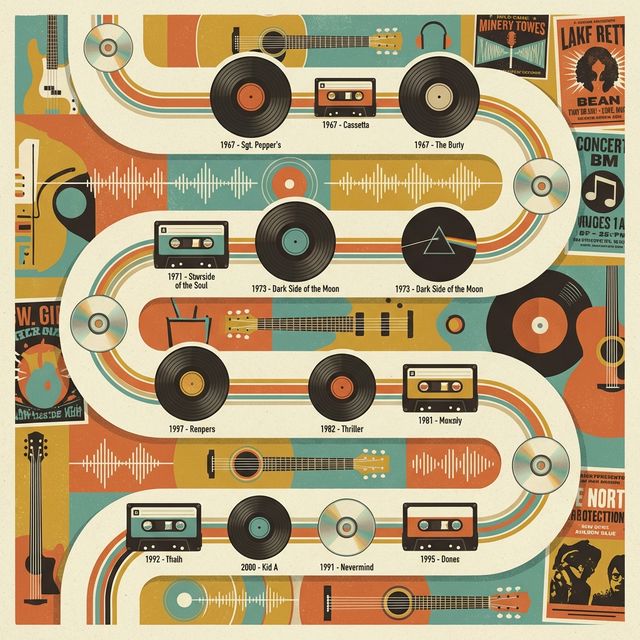
To build a strong mental timeline, you should memorize a set of landmark 'anchor' albums that define their respective eras. The Beatles' 'Sgt. Pepper's Lonely Hearts Club Band' (1967) is the definitive psychedelic-era statement, pushing the limits of 4-track recording. In the 1970s, Led Zeppelin's 'IV' (1971) anchored hard rock, while Pink Floyd's 'The Dark Side of the Moon' (1973) set the standard for progressive rock and analog production quality. Fleetwood Mac's 'Rumours' (1977) represents the pinnacle of 70s soft-rock songwriting and production. The 1980s are defined by Michael Jackson's 'Thriller' (1982), which blended pop, rock, and funk, and Guns N' Roses' 'Appetite for Destruction' (1987), which returned raw energy to hard rock. In the 1990s, Nirvana's 'Nevermind' (1991) ushered in the grunge era, while Radiohead's 'OK Computer' (1997) anticipated the anxieties of the digital age with its atmospheric, experimental production. In the 2000s, Daft Punk's 'Discovery' (2001) bridged house and pop, while Amy Winehouse's 'Back to Black' (2006) revived vintage soul with a modern edge. Kendrick Lamar's 'To Pimp a Butterfly' (2015) and Tyler, The Creator's 'IGOR' (2019) represent the genre-blending, boundary-pushing production of the modern era. Memorizing the release years of these key albums gives you instant reference points for comparison.
Genre Evolution and Timeline Clues
Each musical genre has its own evolutionary path, providing valuable context clues. Rock music evolved from the blues-infused rockabilly of the 50s to the guitar-hero hard rock of the 70s, the synthesized new wave of the 80s, the grunge and alt-rock of the 90s, and the indie/emo rock of the 2000s. Hip-hop began in the late 1970s with simple block party breakbeats, evolved into the sample-heavy Golden Age of the 90s (East vs. West Coast), transitioned into the club-friendly crunk and ringtone rap of the 2000s, and expanded into trap and melodic hip-hop in the 2010s. Electronic music moved from early academic synthesizers to disco in the 70s, house/techno in the 80s, ambient and drum and bass in the 90s, and global EDM in the 2010s. Soul and R&B evolved from Motown in the 60s to funk in the 70s, quiet storm in the 80s, new jack swing in the 90s, and neo-soul/alt-R&B in the 2000s and 2010s. Recognizing where a track falls on its genre's evolutionary timeline is a powerful way to make an educated guess.
Practice Strategies and Tips
Consistent, deliberate practice is essential to improving your score. Start by using the game's genre filters to focus on your strongest area—such as rock or hip-hop—to build confidence and study the patterns within a single category. Pay close attention to the audio sample's production value: if the drums have a huge gated reverb snare, think 1980s; if the vocals have noticeable pitch correction, think post-1998; if the guitars are highly distorted and the recording sounds raw, think early-to-mid 1990s. Additionally, use visual clues from the album cover art: hand-drawn psychedelic art suggests the late 60s or early 70s, high-contrast digital designs and minimalist layouts point toward the 2010s, and high-gloss glamour photography suggests the 80s. Finally, play regularly and review your incorrect guesses—understanding why you were off will help you refine your mental timeline for the next round.
Becoming an Album Year Expert
In conclusion, mastering Album Year Guess is a rewarding journey that deepens your appreciation for the rich history of recorded music. By understanding music eras, recognizing production techniques, learning landmark albums, and practicing consistently, you will see a steady improvement in your guessing accuracy and speed. Every round you play is an opportunity to discover classic music, learn about cultural history, and sharpen your cognitive skills. Keep listening, keep practicing, and enjoy the process of becoming a true music history expert.